
In modern poultry farming, the house environment directly affects the health status, feed intake performance, and production stability of the flock. Particularly under high-density rearing conditions, improper ventilation organization can easily lead to issues such as uneven temperature distribution, excessive humidity, insufficient air circulation, and accumulation of harmful gases within the house.
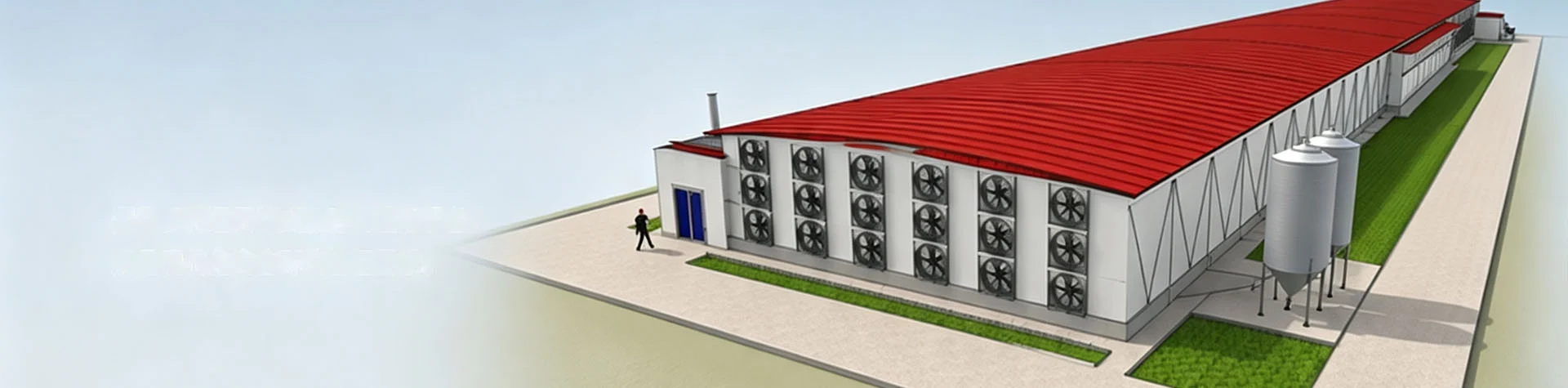
The Farm-Master Environmental Control System is designed for modern poultry houses and can be systematically configured based on house structure, farming scale, local climate, and seasonal ventilation requirements. By rationally combining ventilation and cooling equipment, it provides complete and flexible equipment support for poultry house environmental management.
Four ventilation modes configurable according to poultry house requirements
Given that climatic conditions, poultry house structures, and rearing stages vary across different regions, a single ventilation approach is often insufficient to meet year-round environmental management needs. The Farm-Master Environmental Control System offers four ventilation modes that can be used individually or in combination depending on the actual project conditions.
1. Longitudinal Ventilation
Longitudinal ventilation achieves orderly airflow along the length of the poultry house through the rational placement of air inlets and exhaust equipment.
This mode continuously removes heat, moisture, and stale air from the house while introducing fresh outside air, making it suitable for farming environments that require enhanced overall air exchange. Proper longitudinal airflow also helps reduce ventilation dead zones and improve air quality across different areas of the house.
2. Tunnel Ventilation
Tunnel ventilation is primarily used during hot seasons. The system draws air in from one end of the house and exhausts it intensively from the other, creating a high-velocity directional airflow inside the house.
As air passes over the flock, it generates a wind-chill effect that helps poultry dissipate heat and alleviates heat stress caused by high summer temperatures. Tunnel ventilation can typically be combined with evaporative cooling pad systems to further improve the house environment during hot weather conditions.
3. Gable-End Auxiliary Ventilation
Gable-end auxiliary ventilation involves installing supplementary ventilation equipment at the gable ends of the poultry house to support the primary ventilation system.
This mode enhances airflow in specific areas based on house layout and actual air exchange requirements, helping to expel accumulated hot air and moisture. For poultry houses with extended structures, insufficient local ventilation, or a need for increased exhaust capacity, gable-end auxiliary ventilation can improve overall environmental control performance.
4. Combined Tunnel Ventilation
Combined tunnel ventilation integrates different air intake and exhaust methods, enabling the system to adjust its operating mode based on outdoor temperature, internal house conditions, and the growth stage of the flock.
In regions with pronounced climate variations, this mode can accommodate both routine air exchange and high-temperature cooling requirements, making poultry house ventilation management more flexible. Through proper system design, farms can select matching operational strategies for different seasons, thereby improving equipment utilization efficiency.
Evaporative Cooling Pad System: Enhancing Summer Evaporative Cooling Performance
The evaporative cooling pad is a key cooling component of the Farm-Master Environmental Control System. When outdoor air passes through the uniformly wetted cooling pad, water evaporation absorbs heat from the air, thereby reducing the temperature of the air entering the poultry house.
When used in conjunction with tunnel ventilation, the cooling pad creates a “cooling pad intake, fan exhaust” cooling mode. During hot seasons, the cooled air flows through the interior of the house, helping to alleviate heat stress in poultry and providing a more comfortable growing environment for the flock.
The Farm-Master evaporative cooling pad is available in the following specifications:
| Height H (mm) | 1500, 1800, 2000 | 1500, 1800, 2000 |
| Width W (mm) | 600 | 600 |
| Depth D (mm) | 100, 150 | 100, 150 |
| Wave height h (mm) | 7 | 7 |
| Wave angle α | 45 | 15 |
| Wave angle β | 45 | 45 |
H: height | W: width | D: depth | h: wave height | α: wave angle | β: wave angle
Multiple height and thickness specifications facilitate configuration according to poultry house dimensions, required air intake area, and cooling requirements. In actual projects, the cooling pad area must also be matched with fan exhaust capacity, house airtightness, and local temperature and humidity conditions.
Key Advantages of the Farm-Master Environmental Control System
Flexible Combination of Multiple Modes
Farm-Master offers four ventilation modes—longitudinal ventilation, tunnel ventilation, gable-end auxiliary ventilation, and combined tunnel ventilation—enabling tailored solutions for different poultry house types and climatic conditions, rather than applying a single configuration to all projects.
Coordinated Operation of Ventilation and Cooling
The system allows for integrated configuration of ventilation fans, air intake areas, and evaporative cooling pad equipment, enabling air exchange, heat extraction, and evaporative cooling to work in concert, thereby improving the efficiency of poultry house environmental management.
Improved Indoor Air Quality
Continuous, rational air exchange helps remove heat, moisture, dust, and stale air from the poultry house while introducing fresh air, creating a healthier rearing environment for the flock.
Reduced Risks of High-Temperature Rearing
During hot seasons, the combination of the wind-chill effect generated by tunnel ventilation and evaporative cooling from cooling pads helps poultry dissipate heat, mitigating the adverse effects of high temperatures on feed intake and growth.
Support for Project-Specific Customization
The length, width, stocking density, building structure, and local climate of a poultry house all influence the design of the environmental control system. Farm-Master can configure ventilation modes, fan quantities, cooling pad areas, and equipment layouts based on the specific project.
Applicable to Various Modern Poultry Houses
The Farm-Master Environmental Control System can be used in modern farming projects for laying hens, broilers, pullets, and breeder flocks, and can be integrated with cage equipment, automatic feeding systems, drinking systems, egg collection systems, and manure removal systems.
The system is suitable both for the overall planning of newly constructed poultry houses and for the upgrade of ventilation and cooling systems in existing farms. For customers seeking to improve summer high-temperature conditions, enhance ventilation efficiency, or refine automated house configurations, Farm-Master can provide corresponding environmental control equipment and solution support.
Why choose Farm-Master?
The effectiveness of a poultry house environmental control system depends not only on individual equipment but also on whether fans, cooling pads, air intake areas, and house structure are properly matched with one another.
Farm-Master specializes in poultry farming equipment and related systems, and can provide targeted configuration recommendations based on project location, house dimensions, poultry breed, farming scale, and environmental control objectives. Through project-specific design, various equipment components are coordinated to form a more complete poultry house environmental control solution.
If you are planning a new poultry house or wish to upgrade the ventilation and cooling equipment of an existing farm, please feel free to contact Farm-Master. Please provide the project location, house dimensions, poultry breed, and planned stocking quantity, and Farm-Master will recommend a suitable environmental control system configuration accordingly.


 中文
中文  EN
EN